
A management buyout is, in Wikipedia's definition, "a form of acquisition in which a company's existing managers acquire a large part, or all, of the company, whether from a parent company or individual." In a founder-led business it is often the cleanest handover available. The buyers already know the company, and the seller gets continuity of operations rather than a trade buyer's restructuring, which makes successful performance after the sale more likely. Funding combines four layers: management's own capital, investor equity, senior debt, and money the seller takes later. The part that decides whether the deal works is rarely the price. It is that the management team ends up carrying risk the seller refused to warrant, and that the morning after completion the same people are running the same business with a repayment schedule on top and no owner left to escalate to.
How a management buyout is actually funded
Wikipedia's entry on management buyouts sets out three funding routes: bank debt, private equity and seller financing. The fourth layer is management's own money, which lenders and investors alike treat as evidence that the team believes its own forecast.
Bank debt is the layer founders assume will do most of the work, and the one most likely to disappoint. Buyouts are, in the same source's words, "frequently seen as too risky for a bank to finance the purchase through a loan". Where a private-equity backer funds most of the purchase in exchange for shares, management must still invest personally to demonstrate commitment, and the backers "aim to maximise their return and make an exit after 3–5 years". That exit clock is a term of the deal, and it is the practical difference between growth capital and patient capital.
Seller financing attracts the least scrutiny and causes the most trouble. Under it, "The price paid at the time of sale will be nominal, with the real price being paid over the following years out of the profits of the company. The timescale for the payment is typically 3–7 years." Those are the same profits that service the senior debt.
| Layer | What it is | Who carries the risk | What it costs you |
|---|---|---|---|
| Management equity | The team's own capital | The managers, first and in full | Liquidity, and the first loss |
| Investor equity | A backer funds most of the price for shares | Shared; the investor sets the clock | Ownership, and an exit in three to five years |
| Senior debt | A bank facility secured on the business | The company's cash flow, monthly | Fixed repayments regardless of trading |
| Vendor loan note or deferred consideration | Nominal price now, the real price paid from profits over three to seven years | The seller, waiting after control has passed | Profits committed before they are earned |
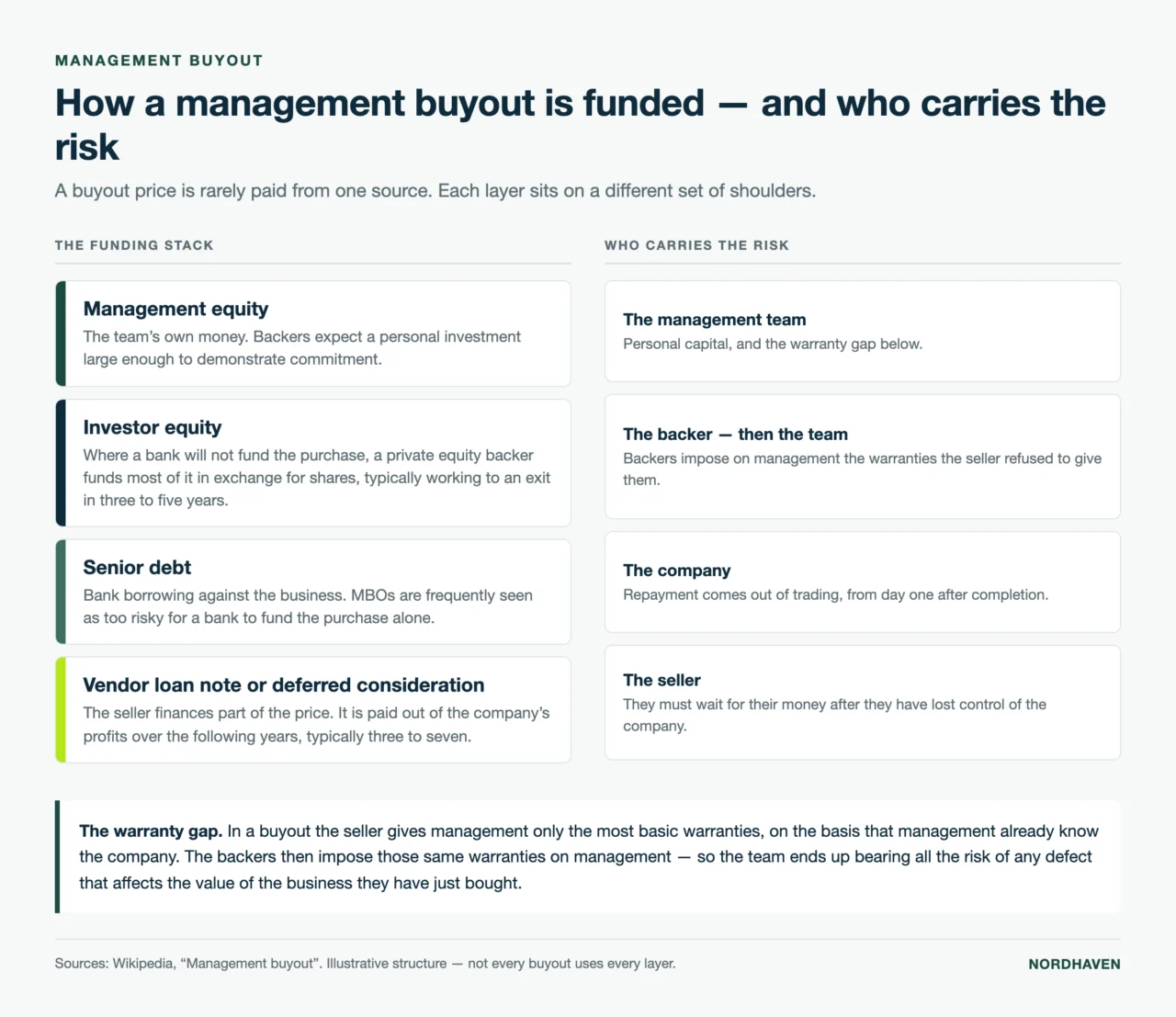
The asymmetry runs one way. A seller's exposure is bounded, though they must "wait to receive its money after it has lost control of the company", and may accept that for a higher overall price or because the consideration is "classified as capital gain rather than as income". Management's is not bounded: every layer above it is repaid out of trading performance the team has personally committed to deliver.
Structuring that stack so the business can still fund its own growth is operational work as much as legal work.
MBO, MBI, BIMBO — which one you are actually doing
The three labels describe who knows the business. An MBO is the incumbent team buying the company it already runs. A management buy-in "occurs when a manager or a management team from outside the company raises the necessary finance, buys it, and becomes the company's new management." A BIMBO is "a combination of a management buy-in and a management buyout", where existing managers retain a stake and individuals join from outside.
Founders often set out to do an MBO and end up with a BIMBO, because the incumbent team is thin in whichever disciplines the founder covered personally. That changes the deal: an incoming member has no operating history with the business, and funders price that in.
The warranty gap nobody mentions
In a buyout, due diligence is "likely to be limited as the buyers already have full knowledge of the company", and the seller is "unlikely to give any but the most basic warranties to the management." That reads like a saving. It is the most expensive feature of the structure.
The reason, in the same source's words: "The backers will invariably impose the same warranties on the management in relation to the company that the sellers will have refused to give the management. This 'warranty gap' means that the management will bear all the risk of any defects in the company that affect its value."

Everything the founder declined to stand behind lands on the people who ran the business for them. A supplier arrangement that was always personal to the founder is not a hypothetical defect in a company no outsider has examined. Run real diligence on your own business, because nobody else will.
What changes the morning after completion
Managers do buyouts to "get the financial reward for the future development of the company more directly than they would do as employees only." That reward is real. So is the operating change nobody rehearses, which arrives on day one.
The same people run the same business. What is new is a repayment schedule, an investor with a defined exit horizon, and no owner to escalate to. Decisions the founder used to absorb in the evening, without a meeting, now have no home. We treat a buyout as re-architecture rather than a change of shareholder register, because the structures that carry a business through its next stage are not the ones that got it here, as we set out in our guide to how to scale a business.
Teams usually fill that gap by hiring, which is slow and assumes they already know the shape of the role. The alternative is to buy the capability by the fraction: a fractional COO is your own hire, paid by you, who owns and runs operations part-time, and "fractional" describes the commitment rather than the seniority, as we set out in what a fractional COO does. Our own model is different again: an operating partner sits on the investor's side, comes with the capital, is aligned through carried interest and stays active from diligence through to exit, so our return depends on the same operating result the management team has signed up to. For a recruitment startup, Nordhaven ran marketing, IT, compliance and finance across roughly a twelve-month runway.
What the business needs in order to run without its founder is a conversation for before completion.
The market you are buying in
Debt is the broader half of the picture. The British Business Bank's Small Business Finance Markets 2025/26 reports UK gross SME bank lending excluding overdrafts of £68bn in 2025, up 9% on 2024 and the second highest since records began in 2012. Composition has changed more than volume: challenger and specialist banks took 60% of that lending, up from 39% in 2012, and non-bank lenders now provide £18.3bn.

Equity moved the other way. The British Business Bank's Small Business Equity Tracker 2026 records £12.3 billion raised by UK smaller businesses in 2025, down 4% on £12.8 billion in 2024, across 2,002 announced deals: a 17% decline and the lowest annual count since 2016, against a 2021 peak of 3,209. Fewer, larger cheques means a higher bar for the equity layer of your stack.
Common mistakes we see
The most common is negotiating the headline price hard and the vendor loan note softly. A deferred structure that depends on returned profits increasing significantly is a forecast, not a payment plan, and management absorbs the difference if the increase does not arrive.
The second is treating limited diligence as a benefit rather than as the mechanism that transfers unknown defects onto the buying team.
The third is running the transaction with the same people who run the business, without deciding who does which. An impending buyout can create principal-agent problems and moral hazard, and the asymmetric information held by management "may offer them unfair advantage relative to current owners". Settling roles early protects a relationship with a seller you still depend on.
Frequently asked questions
The questions management teams ask us most often before a buyout.
How is a management buyout funded?
Through some combination of management's own capital, investor equity, senior bank debt and seller financing. Banks frequently regard buyouts as too risky to fund the purchase through a loan, so management is expected to invest significant personal capital, and a private-equity backer requires the same.
What is a vendor loan note?
It is the form of seller financing in which the price paid at completion is nominal and the real price is paid over the following years out of the profits of the company, typically over three to seven years. Those profits also service the senior debt.
What is the difference between an MBO, an MBI and a BIMBO?
An MBO is the existing management team buying the company. A management buy-in occurs when a manager or team from outside raises the finance, buys the company and becomes its new management. A BIMBO combines the two: existing managers keep a stake alongside individuals from outside.
Why would a founder accept deferred payment?
It can secure a higher overall price, the consideration is classified as capital gain rather than as income, and the incumbent team gives continuity of operations. The disadvantage is waiting for the money once control has passed.
What is the warranty gap in a management buyout?
Sellers are unlikely to give more than the most basic warranties, on the basis that the buyers already know the company. Backers impose those same warranties on management anyway, so the team bears all the risk of any defects that affect the company's value.
If a buyout is on the table and you want the operating plan tested before the funding structure is fixed, we should talk.
The buyout itself takes months; servicing it takes three to seven years of operating discipline, and only one of those is negotiable.